
6,1K
Accede a toda la información aquí.
📨 Newsletter


Hazte miembro de Cometografía...
...y accede al contenido extendido: pronósticos de brillo, condiciones de visibilidad, mapas celestes, conjunciones, cartas en PDF, efemérides diarias y el boletín exclusivo Tiempo de cometas.
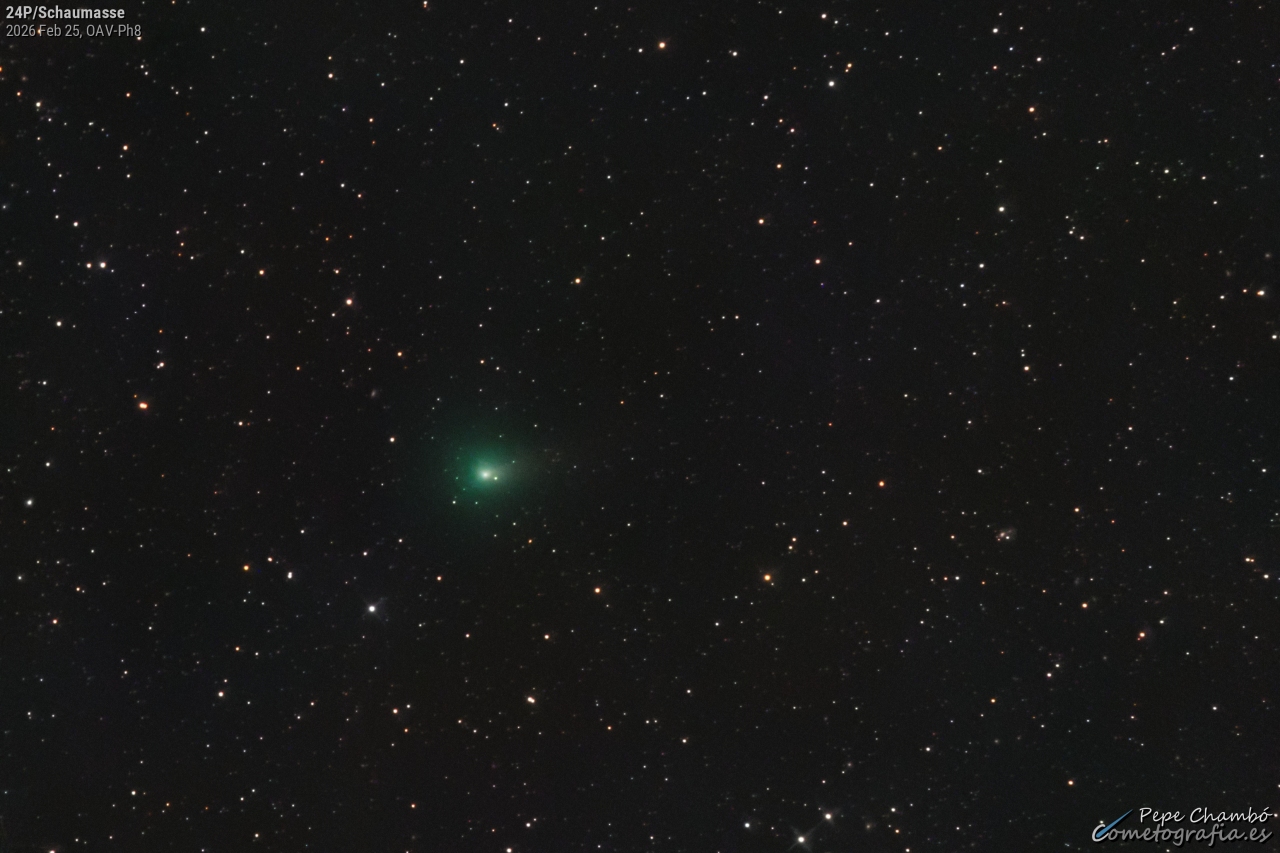
El cometa 24P/Schaumasse, fotografiado el 25 de febrero de 2026, se presentaba ya en claro declive con un brillo en torno a la magnitud 10.6, pero aún lo suficientemente activo como para mostrar una coma verde bien desarrollada y con una marcada condensación central.
En la imagen se aprecia ese característico tono verdoso, dominado por emisiones gaseosas, concentrándose en un núcleo brillante rodeado por una envoltura más difusa. A pesar de su evolución descendente, el cometa mantiene todavía una pequeña pero evidente cola, corta y tenue, compuesta por gas y algo de polvo, que se extiende discretamente desde la coma sin destacar con gran contraste sobre el fondo estelar.
El campo estelar, denso y rico, sitúa al cometa en la constelación de Serpens (Caput), una región del cielo que en estas fechas empieza a ganar protagonismo en la madrugada. No hay objetos especialmente brillantes que compitan con el cometa, lo que permite que su presencia, aunque modesta, se identifique con claridad entre el fondo de estrellas.
La obtención de la imagen tuvo su pequeña historia: capturada de forma automática mientras yo dormía —noche entre semana y jornada laboral a la mañana siguiente—, los datos resultaron afectados por un fuerte gradiente de origen incierto. Aun así, tras pelear el procesado, ha sido posible rescatar una imagen más que digna de este ya menguante 24P, que se resiste a despedirse sin dejar todavía un último rastro de actividad.
Hay noches en las que uno no observa… pero el telescopio sí. Y a veces, incluso medio dormido, el cielo te deja algo aprovechable.
En la imagen se aprecia ese característico tono verdoso, dominado por emisiones gaseosas, concentrándose en un núcleo brillante rodeado por una envoltura más difusa. A pesar de su evolución descendente, el cometa mantiene todavía una pequeña pero evidente cola, corta y tenue, compuesta por gas y algo de polvo, que se extiende discretamente desde la coma sin destacar con gran contraste sobre el fondo estelar.
El campo estelar, denso y rico, sitúa al cometa en la constelación de Serpens (Caput), una región del cielo que en estas fechas empieza a ganar protagonismo en la madrugada. No hay objetos especialmente brillantes que compitan con el cometa, lo que permite que su presencia, aunque modesta, se identifique con claridad entre el fondo de estrellas.
La obtención de la imagen tuvo su pequeña historia: capturada de forma automática mientras yo dormía —noche entre semana y jornada laboral a la mañana siguiente—, los datos resultaron afectados por un fuerte gradiente de origen incierto. Aun así, tras pelear el procesado, ha sido posible rescatar una imagen más que digna de este ya menguante 24P, que se resiste a despedirse sin dejar todavía un último rastro de actividad.
Hay noches en las que uno no observa… pero el telescopio sí. Y a veces, incluso medio dormido, el cielo te deja algo aprovechable.
───── ⋆⋅☆⋅⋆ ─────
Comet 24P/Schaumasse, imaged on February 25, 2026, was already in clear decline, at around magnitude 10.6, yet still active enough to show a well-developed green coma with a distinct central condensation.
The image shows that characteristic greenish hue, dominated by gaseous emissions, concentrated toward a bright inner region and fading smoothly into a more diffuse outer coma. Despite its waning activity, the comet still displays a short, faint tail, made of gas and some dust, extending subtly from the coma without standing out strongly against the star field.
The dense stellar background places the comet in Serpens (Caput), a region of the sky that starts to rise into better view in the early morning hours at this time of year. There are no particularly bright objects nearby, allowing the comet’s modest glow to remain clearly visible among the surrounding stars.
There was also a small backstory to this image: it was captured automatically while I was asleep — a weekday night with work the next morning — and the data turned out to be affected by a strong gradient of unknown origin. Even so, after some careful processing, it was possible to recover a more than decent image of this fading 24P, still not quite ready to fade away without leaving one last trace of activity.
Some nights you’re not observing… but your telescope is. And sometimes, even half asleep, the sky still leaves you something worth keeping.
The image shows that characteristic greenish hue, dominated by gaseous emissions, concentrated toward a bright inner region and fading smoothly into a more diffuse outer coma. Despite its waning activity, the comet still displays a short, faint tail, made of gas and some dust, extending subtly from the coma without standing out strongly against the star field.
The dense stellar background places the comet in Serpens (Caput), a region of the sky that starts to rise into better view in the early morning hours at this time of year. There are no particularly bright objects nearby, allowing the comet’s modest glow to remain clearly visible among the surrounding stars.
There was also a small backstory to this image: it was captured automatically while I was asleep — a weekday night with work the next morning — and the data turned out to be affected by a strong gradient of unknown origin. Even so, after some careful processing, it was possible to recover a more than decent image of this fading 24P, still not quite ready to fade away without leaving one last trace of activity.
Some nights you’re not observing… but your telescope is. And sometimes, even half asleep, the sky still leaves you something worth keeping.
Objeto/Fecha
Cometa 24P/Schaumasse @ 25 de febrero de 2026, 04:28 UT

Datos de captura
Telescopio/Objetivo TS-Photon 8 f/4"
Montura SkyWatcher EQ6R-Pro
Cámara Atik 383L+
Exposición total 53 min.
Desde Vallés, Valencia (Spain)
Créditos
José J. Chambó, cometografia.esTodo sobre el cometa Cometa 24P/Schaumasse
Elementos orbitales, curvas de luz y morfología, descubrimiento, cronología de su evolución con imágenes.Accede a toda la información aquí.
Galería del cometa Cometa 24P/Schaumasse
📨 Newsletter
Hazte miembro de Cometografía...
...y accede al contenido extendido: pronósticos de brillo, condiciones de visibilidad, mapas celestes, conjunciones, cartas en PDF, efemérides diarias y el boletín exclusivo Tiempo de cometas.