
7K
Accede a toda la información aquí.
📨 Newsletter


Hazte miembro de Cometografía...
...y accede al contenido extendido: pronósticos de brillo, condiciones de visibilidad, mapas celestes, conjunciones, cartas en PDF, efemérides diarias y el boletín exclusivo Tiempo de cometas.
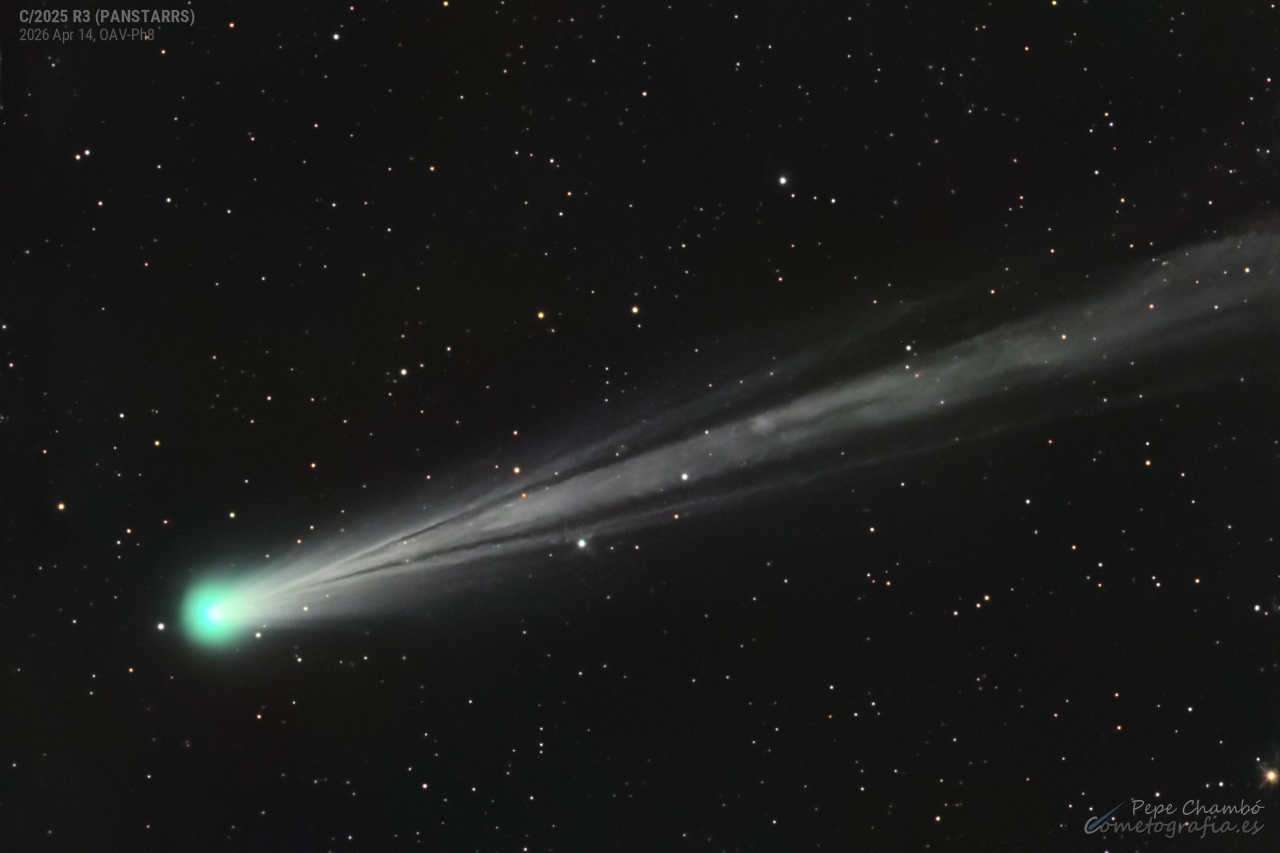
El cometa C/2025 R3 (PANSTARRS), fotografiado el 14 de abril de 2026 en la constelación de Pegaso, mostraba entonces un brillo en torno a magnitud 5, suficiente para ser observable con binoculares, mientras desplegaba una larga y estructurada cola que se extendía a lo largo de más de una decena de grados.
Esta imagen supone mi última captura del cometa desde el observatorio, tomada justo antes de que se perdiera definitivamente en el crepúsculo matutino y dejara de ser accesible desde el hemisferio norte. La sesión estuvo marcada por condiciones poco favorables: el cometa se encontraba muy bajo sobre el horizonte, con el cielo ya afectado por la luz del amanecer y además con la presencia de la Luna menguante iluminando el fondo.
El planteamiento inicial era ambicioso, intentando componer un mosaico de dos teselas para abarcar una mayor extensión de la cola. Sin embargo, la segunda quedó descartada al comprobar que los datos estaban claramente degradados por la creciente luz del día, quedando esta imagen como el resultado final de la sesión.
A pesar de ello, el procesado —que en este caso he replanteado casi por completo— ha permitido resaltar con bastante detalle la compleja estructura de la cola iónica. En ella se aprecian múltiples filamentos y variaciones de brillo que invitan a recorrerla visualmente, casi como si se pudiera seguir el flujo del material alejándose de la intensa coma verdosa del cometa.
En la imagen sólo queda recogida la parte inicial más brillante de la cola, aunque en esos días su desarrollo alcanzaba longitudes mucho mayores en el cielo, reforzando la impresión de dinamismo que transmitía incluso en observación visual.
Última imagen antes de que el cometa se apagara en el amanecer… prácticamente a contrarreloj frente a la luz del día.
Esta imagen supone mi última captura del cometa desde el observatorio, tomada justo antes de que se perdiera definitivamente en el crepúsculo matutino y dejara de ser accesible desde el hemisferio norte. La sesión estuvo marcada por condiciones poco favorables: el cometa se encontraba muy bajo sobre el horizonte, con el cielo ya afectado por la luz del amanecer y además con la presencia de la Luna menguante iluminando el fondo.
El planteamiento inicial era ambicioso, intentando componer un mosaico de dos teselas para abarcar una mayor extensión de la cola. Sin embargo, la segunda quedó descartada al comprobar que los datos estaban claramente degradados por la creciente luz del día, quedando esta imagen como el resultado final de la sesión.
A pesar de ello, el procesado —que en este caso he replanteado casi por completo— ha permitido resaltar con bastante detalle la compleja estructura de la cola iónica. En ella se aprecian múltiples filamentos y variaciones de brillo que invitan a recorrerla visualmente, casi como si se pudiera seguir el flujo del material alejándose de la intensa coma verdosa del cometa.
En la imagen sólo queda recogida la parte inicial más brillante de la cola, aunque en esos días su desarrollo alcanzaba longitudes mucho mayores en el cielo, reforzando la impresión de dinamismo que transmitía incluso en observación visual.
Última imagen antes de que el cometa se apagara en el amanecer… prácticamente a contrarreloj frente a la luz del día.
───── ⋆⋅☆⋅⋆ ─────
Comet C/2025 R3 (PANSTARRS), imaged on April 14, 2026 in the constellation Pegasus, was shining at around magnitude 5—bright enough for binocular observation—while displaying a long, well-structured tail extending for more than ten degrees.
This image marks my final capture of the comet from my observatory, taken just before it disappeared into the morning twilight and became unobservable from the northern hemisphere. The session took place under challenging conditions, with the comet sitting very low above the horizon, already affected by dawn light and further impacted by the waning Moon brightening the sky.
The original plan was to create a two-panel mosaic to capture more of the tail, but I ultimately discarded the second panel due to the clearly degraded data caused by the advancing daylight, leaving this as the final result of the session.
Even so, the processing—largely reworked for this image—allowed me to bring out the intricate structure of the ion tail. Multiple filaments and brightness variations can be traced along it, inviting the eye to follow their flow as they stream away from the comet’s intense greenish coma.
Only the brightest inner section of the tail fits within this field of view, although at the time it extended much farther across the sky, enhancing the sense of motion already evident even through visual observation.
My last image before the comet faded into the dawn… taken just in time, with daylight already closing in.
This image marks my final capture of the comet from my observatory, taken just before it disappeared into the morning twilight and became unobservable from the northern hemisphere. The session took place under challenging conditions, with the comet sitting very low above the horizon, already affected by dawn light and further impacted by the waning Moon brightening the sky.
The original plan was to create a two-panel mosaic to capture more of the tail, but I ultimately discarded the second panel due to the clearly degraded data caused by the advancing daylight, leaving this as the final result of the session.
Even so, the processing—largely reworked for this image—allowed me to bring out the intricate structure of the ion tail. Multiple filaments and brightness variations can be traced along it, inviting the eye to follow their flow as they stream away from the comet’s intense greenish coma.
Only the brightest inner section of the tail fits within this field of view, although at the time it extended much farther across the sky, enhancing the sense of motion already evident even through visual observation.
My last image before the comet faded into the dawn… taken just in time, with daylight already closing in.
Objeto/Fecha
Cometa C/2025 R3 (PANSTARRS) @ 14 de abril de 2026, 04:11 UT

Datos de captura
Telescopio/Objetivo TS-Photon 8 f/4"
Montura SkyWatcher EQ6R-Pro
Cámara Atik 383L+
Exposición total 9 min.
Desde Vallés, Valencia (Spain)
Créditos
José J. Chambó, cometografia.esTodo sobre el cometa Cometa C/2025 R3 (PANSTARRS)
Elementos orbitales, curvas de luz y morfología, descubrimiento, cronología de su evolución con imágenes.Accede a toda la información aquí.
Galería del cometa Cometa C/2025 R3 (PANSTARRS)
📨 Newsletter
Hazte miembro de Cometografía...
...y accede al contenido extendido: pronósticos de brillo, condiciones de visibilidad, mapas celestes, conjunciones, cartas en PDF, efemérides diarias y el boletín exclusivo Tiempo de cometas.