
284
Accede a toda la información aquí.
📨 Newsletter


Hazte miembro de Cometografía...
...y accede al contenido extendido: pronósticos de brillo, condiciones de visibilidad, mapas celestes, conjunciones, cartas en PDF, efemérides diarias y el boletín exclusivo Tiempo de cometas.
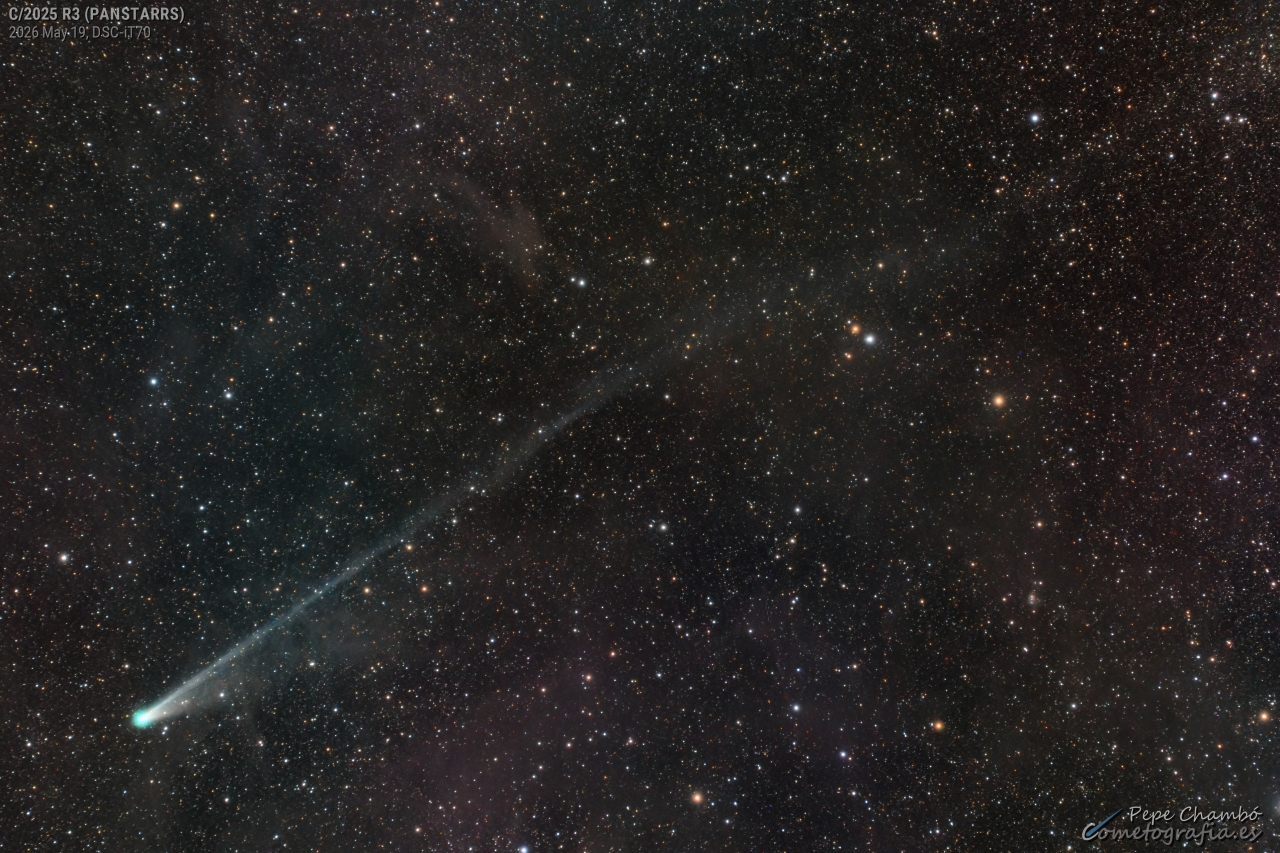
El cometa C/2025 R3 (PANSTARRS) fotografiado el 19 de mayo de 2026, justo cuando mostraba su cola más espectacular sobre un rico fondo de nubes interestelares y campos estelares de invierno austral.
Prácticamente al mismo tiempo que obtenía una imagen más cerrada centrada en la coma y la región más brillante de la cola, decidí realizar una segunda serie de tomas de gran campo con el objetivo de registrar la máxima extensión posible del cometa. El resultado fue una visión muy diferente del mismo objeto, en la que la protagonista absoluta es su larguísima cola iónica recorriendo buena parte del encuadre.
Con un brillo cercano a magnitud 7, el cometa presentaba una intensa coma verdeazulada rodeando una condensación central brillante. Desde ella emergían dos estructuras claramente diferenciadas: una cola de polvo más corta y abierta junto a la cabeza, y una espectacular cola iónica estrecha que, tras un inicio rectilíneo, adquiere un marcado aspecto sinuoso. El trazado completo alcanza aproximadamente 6.5 grados de longitud, extendiéndose desde Monoceros hacia Canis Major.
La imagen también pone de manifiesto el entorno celeste por el que transitaba el cometa. Su cola parece deslizarse entre extensas nubes de hidrógeno y regiones oscuras de polvo interestelar características de esta zona de la Vía Láctea, formando una composición especialmente rica en matices y estructuras tenues.
Al final, aquella segunda fotografía tomada por si acaso" terminó mostrando mucho más: reveló hasta dónde llegaba realmente su cola."
Prácticamente al mismo tiempo que obtenía una imagen más cerrada centrada en la coma y la región más brillante de la cola, decidí realizar una segunda serie de tomas de gran campo con el objetivo de registrar la máxima extensión posible del cometa. El resultado fue una visión muy diferente del mismo objeto, en la que la protagonista absoluta es su larguísima cola iónica recorriendo buena parte del encuadre.
Con un brillo cercano a magnitud 7, el cometa presentaba una intensa coma verdeazulada rodeando una condensación central brillante. Desde ella emergían dos estructuras claramente diferenciadas: una cola de polvo más corta y abierta junto a la cabeza, y una espectacular cola iónica estrecha que, tras un inicio rectilíneo, adquiere un marcado aspecto sinuoso. El trazado completo alcanza aproximadamente 6.5 grados de longitud, extendiéndose desde Monoceros hacia Canis Major.
La imagen también pone de manifiesto el entorno celeste por el que transitaba el cometa. Su cola parece deslizarse entre extensas nubes de hidrógeno y regiones oscuras de polvo interestelar características de esta zona de la Vía Láctea, formando una composición especialmente rica en matices y estructuras tenues.
Al final, aquella segunda fotografía tomada por si acaso" terminó mostrando mucho más: reveló hasta dónde llegaba realmente su cola."
───── ⋆⋅☆⋅⋆ ─────
Comet C/2025 R3 (PANSTARRS) imaged on May 19, 2026, just as it was displaying its most impressive tail against a rich backdrop of interstellar clouds and the dense star fields of the southern winter Milky Way.
At nearly the same time I was capturing a closer view focused on the coma and brightest section of the tail, I also acquired a second wide-field image with a different goal in mind: to record as much of the comet's tail as possible. The result was a completely different perspective of the same object, one in which the immense ion tail becomes the main attraction, stretching across a large portion of the field.
Shining at around magnitude 7, the comet showed a vivid bluish-green coma surrounding a bright central condensation. Two distinct tail components were visible: a shorter, broader dust tail emerging from the head, and a remarkably narrow ion tail that begins almost straight before developing a pronounced wavy structure. The full extent visible in this image reaches approximately 6.5 degrees, spanning the sky from Monoceros into Canis Major.
The image also highlights the rich celestial scenery through which the comet was moving. Its tail appears to weave its way across extensive hydrogen clouds and dark interstellar dust lanes that characterize this region of the Milky Way, creating a particularly rewarding wide-field view filled with subtle detail.
In the end, that extra image taken just in case" revealed something unexpected: how far the comet's tail actually extended."
At nearly the same time I was capturing a closer view focused on the coma and brightest section of the tail, I also acquired a second wide-field image with a different goal in mind: to record as much of the comet's tail as possible. The result was a completely different perspective of the same object, one in which the immense ion tail becomes the main attraction, stretching across a large portion of the field.
Shining at around magnitude 7, the comet showed a vivid bluish-green coma surrounding a bright central condensation. Two distinct tail components were visible: a shorter, broader dust tail emerging from the head, and a remarkably narrow ion tail that begins almost straight before developing a pronounced wavy structure. The full extent visible in this image reaches approximately 6.5 degrees, spanning the sky from Monoceros into Canis Major.
The image also highlights the rich celestial scenery through which the comet was moving. Its tail appears to weave its way across extensive hydrogen clouds and dark interstellar dust lanes that characterize this region of the Milky Way, creating a particularly rewarding wide-field view filled with subtle detail.
In the end, that extra image taken just in case" revealed something unexpected: how far the comet's tail actually extended."
Objeto/Fecha
Cometa C/2025 R3 (PANSTARRS) @ 19 de mayo de 2026, 00:02 UT

Datos de captura
Telescopio/Objetivo Samyang 135 f/2
Montura Paramount ME
Cámara ZWO ASI 2600 MM
Exposición total 42 min.
Desde Río Hurtado, Coquimbo (Chile)
Créditos
José J. Chambó, cometografia.esTodo sobre el cometa Cometa C/2025 R3 (PANSTARRS)
Elementos orbitales, curvas de luz y morfología, descubrimiento, cronología de su evolución con imágenes.Accede a toda la información aquí.
Galería del cometa Cometa C/2025 R3 (PANSTARRS)
📨 Newsletter
Hazte miembro de Cometografía...
...y accede al contenido extendido: pronósticos de brillo, condiciones de visibilidad, mapas celestes, conjunciones, cartas en PDF, efemérides diarias y el boletín exclusivo Tiempo de cometas.