
295
Accede a toda la información aquí.
📨 Newsletter


Hazte miembro de Cometografía...
...y accede al contenido extendido: pronósticos de brillo, condiciones de visibilidad, mapas celestes, conjunciones, cartas en PDF, efemérides diarias y el boletín exclusivo Tiempo de cometas.
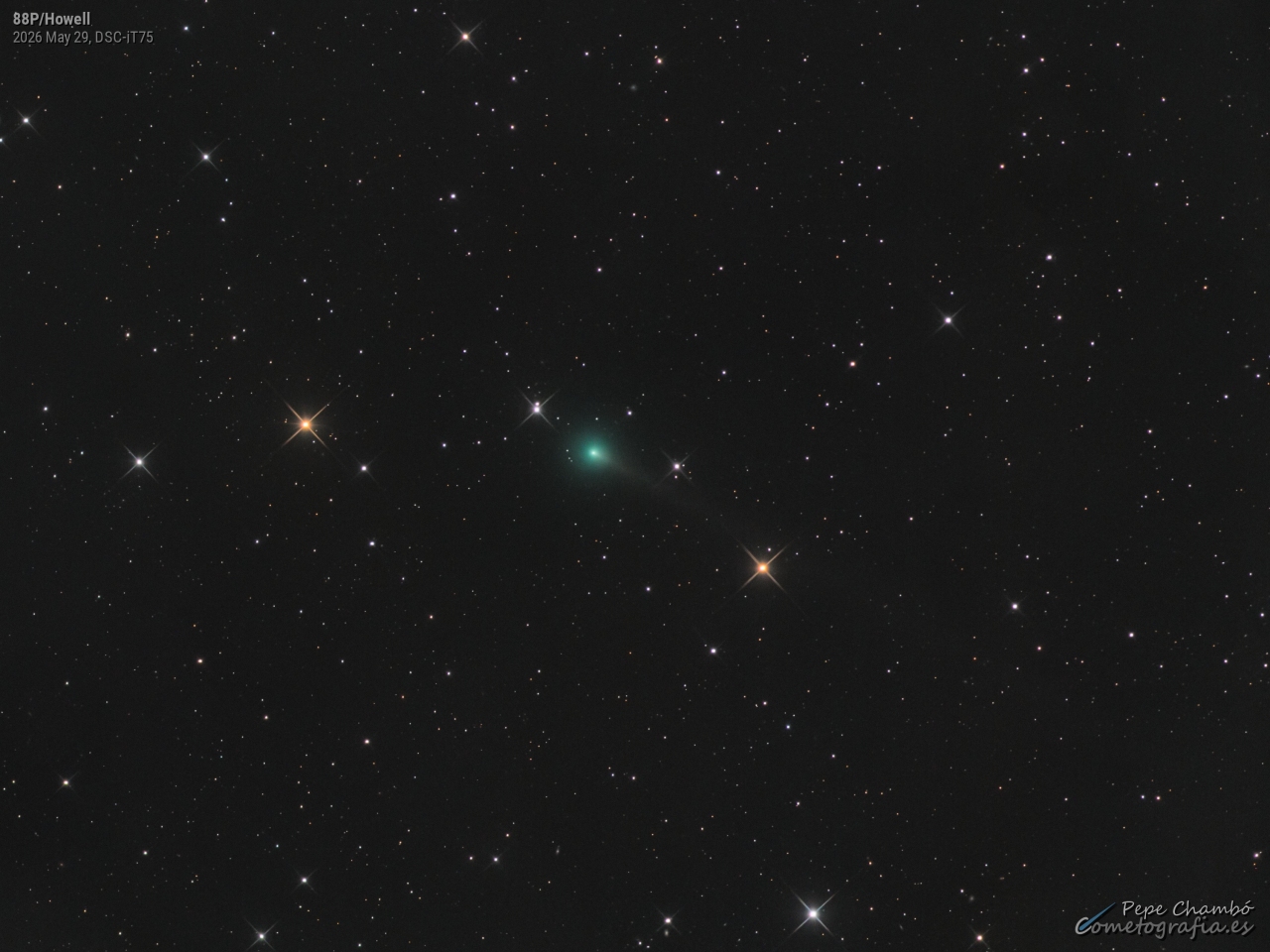
El cometa 88P/Howell, fotografiado el 29 de mayo de 2026 con un brillo cercano a magnitud 11, continúa alejándose del Sol, pero se resiste a perder protagonismo. En el último mes apenas ha disminuido unas décimas de magnitud, manteniendo una actividad estable.
Su característica coma de color esmeralda conserva un aspecto muy similar al mostrado semanas atrás. Se presenta amplia, claramente gaseosa y con una condensación central bien definida, reflejando que el cometa sigue liberando cantidades apreciables de gas pese a encontrarse ya en retirada tras su perihelio.
La evolución más evidente se aprecia en la cola. Apenas insinuada en mi imagen anterior, ha ganado intensidad y extensión hasta alcanzar aproximadamente medio grado de longitud aparente. Aunque tenue, resulta claramente detectable y aporta una presencia mucho más dinámica al conjunto que la observada un mes antes.
El cometa recorre en estas fechas la frontera entre las constelaciones de Cetus y Pisces, una región relativamente despejada del cielo. Dos estrellas anaranjadas de magnitud cercana a la octava destacan en el campo y ofrecen un atractivo contraste cromático con los tonos verdosos de la coma, convirtiéndose en los acompañantes más llamativos de la escena.
Un mes después, el brillo apenas ha cambiado; la cola ha aportado casi toda la evolución visible del cometa.
Su característica coma de color esmeralda conserva un aspecto muy similar al mostrado semanas atrás. Se presenta amplia, claramente gaseosa y con una condensación central bien definida, reflejando que el cometa sigue liberando cantidades apreciables de gas pese a encontrarse ya en retirada tras su perihelio.
La evolución más evidente se aprecia en la cola. Apenas insinuada en mi imagen anterior, ha ganado intensidad y extensión hasta alcanzar aproximadamente medio grado de longitud aparente. Aunque tenue, resulta claramente detectable y aporta una presencia mucho más dinámica al conjunto que la observada un mes antes.
El cometa recorre en estas fechas la frontera entre las constelaciones de Cetus y Pisces, una región relativamente despejada del cielo. Dos estrellas anaranjadas de magnitud cercana a la octava destacan en el campo y ofrecen un atractivo contraste cromático con los tonos verdosos de la coma, convirtiéndose en los acompañantes más llamativos de la escena.
Un mes después, el brillo apenas ha cambiado; la cola ha aportado casi toda la evolución visible del cometa.
───── ⋆⋅☆⋅⋆ ─────
Comet 88P/Howell, imaged on May 29, 2026 at around magnitude 11, continues to recede from the Sun while showing little sign of fading. Over the past month its brightness has dropped by only a few tenths of a magnitude, maintaining a remarkably consistent appearance.
Its distinctive emerald-green coma looks much the same as it did a few weeks earlier. Broad and strongly gas-rich in appearance, it remains centered on a well-defined condensation, indicating that the comet is still releasing substantial amounts of gas despite moving farther from the Sun after perihelion.
The most noticeable change is found in the tail. Barely detectable in my previous image, it has grown both brighter and longer, extending to roughly half a degree across the sky. Although still faint, it now stands out clearly and gives the comet a much more dynamic appearance than it had just a month ago.
At the time of this image, the comet was crossing the border region between Cetus and Pisces, an otherwise sparse area of the sky. A pair of orange eighth-magnitude stars provides an appealing color contrast against the green glow of the coma, becoming the most eye-catching companions in the field.
A month later, the brightness has changed very little; almost all of the comet's visible evolution has taken place in the tail.
Its distinctive emerald-green coma looks much the same as it did a few weeks earlier. Broad and strongly gas-rich in appearance, it remains centered on a well-defined condensation, indicating that the comet is still releasing substantial amounts of gas despite moving farther from the Sun after perihelion.
The most noticeable change is found in the tail. Barely detectable in my previous image, it has grown both brighter and longer, extending to roughly half a degree across the sky. Although still faint, it now stands out clearly and gives the comet a much more dynamic appearance than it had just a month ago.
At the time of this image, the comet was crossing the border region between Cetus and Pisces, an otherwise sparse area of the sky. A pair of orange eighth-magnitude stars provides an appealing color contrast against the green glow of the coma, becoming the most eye-catching companions in the field.
A month later, the brightness has changed very little; almost all of the comet's visible evolution has taken place in the tail.
Objeto/Fecha
Cometa 88P/Howell @ 29 de mayo de 2026, 10:11 UT

Datos de captura
Telescopio/Objetivo ASA N250 Astrograph f/3.6
Montura Paramount MyT
Cámara ZWO ASI 6200 MM
Exposición total 12 min.
Desde Río Hurtado, Coquimbo (Chile)
Créditos
José J. Chambó, cometografia.esTodo sobre el cometa Cometa 88P/Howell
Elementos orbitales, curvas de luz y morfología, descubrimiento, cronología de su evolución con imágenes.Accede a toda la información aquí.
Galería del cometa Cometa 88P/Howell
📨 Newsletter
Hazte miembro de Cometografía...
...y accede al contenido extendido: pronósticos de brillo, condiciones de visibilidad, mapas celestes, conjunciones, cartas en PDF, efemérides diarias y el boletín exclusivo Tiempo de cometas.